

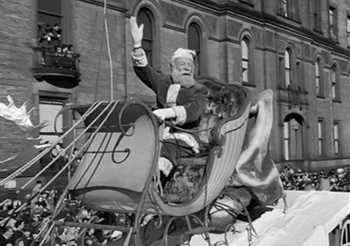
Traditions can be wonder-full things. And we think it can also be helpful to remember that they are created things, things we repeat to remind ourselves of what we value and what we love.
We at The Serious Mirth Society are surprised to realize our traditions now involve an annual holiday screening of “Miracle on 34th Street.” (And always the original black and white version—it’s imperative.) It’s surprising to us because every year we become increasingly aware of what a tremendous comedy of errors and tragedy of logical fallacies it is—arguably a promotion of material greed, an oversimplification of life, and quite an abominably messed-up definition of “faith.”
Every year we have new arguments about what’s wrong with this movie.
And yet we keep watching it.
(And—spoiler alert—maybe you’d like to go watch it, too, before you keep reading this.)
Why do we do this, year after year?
Well, we find we keep learning things, mostly about ourselves.
One thing we realized, just this year, is that what we’re seeing, under all the logical silliness, is that people support this particular Kris Kringle because of who he is, not just the name on his pay stub. They are drawn to this man specifically for how he lives. (Because they certainly weren’t so keen on the inebriated “Santa” he replaced in the Macy’s parade.) This Kris is admired for being kind, helpful, friendly, joyful, playful, imaginative, quick to laugh (even at himself), concerned for the happiness of others, and moves through life with ease. He stays calm even when personally attacked, but will also honestly and deftly confront people causing harm. He seeks justice.
This Kris Kringle didn’t have an agenda. He didn’t intend to start a huge department store goodwill campaign. He didn’t need to prove he was Santa Claus. He just moved along with life as it happened, embodying what he valued. He was just himself. Consistently.
It became very clear to us that what people loved and what they wanted to be real wasn’t “Santa” or the costume. It was the kind of person who was wearing that costume. And because of Kris, people noticed that those qualities were coming to life in themselves as well.
(A whole other discussion ensued as to how so many of us settle for idealizing people who wear a costume even when they don’t embody its values. A topic for another time, perhaps.)

Our final epiphany this year was that the villain should really get more credit for how far Kris’s joy spread. Without the miserable, spiteful Mr. Sawyer (the self-proclaimed “sane” person who lashed out and tried to punish Kris), there would’ve been no court trial, no national publicity or attention. Mr. Sawyer’s smallness was the catalyst for something good to grow even bigger.
Yes, of course, we admit some malevolent satisfaction at Mr. Sawyer getting fired (“Hooray for justice!”). But then we remembered that even Kris Kringle didn’t wish for Mr. Sawyer to be miserable—just held accountable. And even more, somehow, for him to be happy. Not as he is, in his pinched, Grinchy state. But maybe there’s the hope that he can grow.
And thus, our wish for everyone—may you all be happy. Spread mirth and cheer like Kris.
Tune in again next year, for tales of an exuberant discussion regarding the ethics of “Emmet Otter’s Jugband Christmas.” Remember, traditions are surprising things—especially, when you keep asking yourself why you do them.
 The Serious Mirth Society