

It’s an understatement to say that we’re living in stressful times. The pressure is affecting us all to varying degrees, and some days it feels like there will be no release. And yet people are still choosing to speak of hope, meaning, and the importance of continued effort. We were very skeptical to say the least. Where is this energy supposed to come from, when so many people are being pressed down, mocked, and silenced? And so we started thinking of other things that feel pressure and of how they respond. Which is when we started thinking about round rubber balls. And how we started thinking about resiliency. And physics.
A round rubber ball can endure quite a violent life—being thrown, hit, or kicked around in any number of ways. But what fascinated us is how it responds when it’s not just hit again or caught safely by welcoming hands. When left to its own devices, a round rubber ball does something very interesting when it meets a surface—it stretches, it bounces, and then it rests.
And as we thought more and more about that bounce, we realized that’s the ball’s natural response to stress. In fact, it’s the expression of release from the stress of impact. Want to learn about bounce? Pretend you’re a ball.
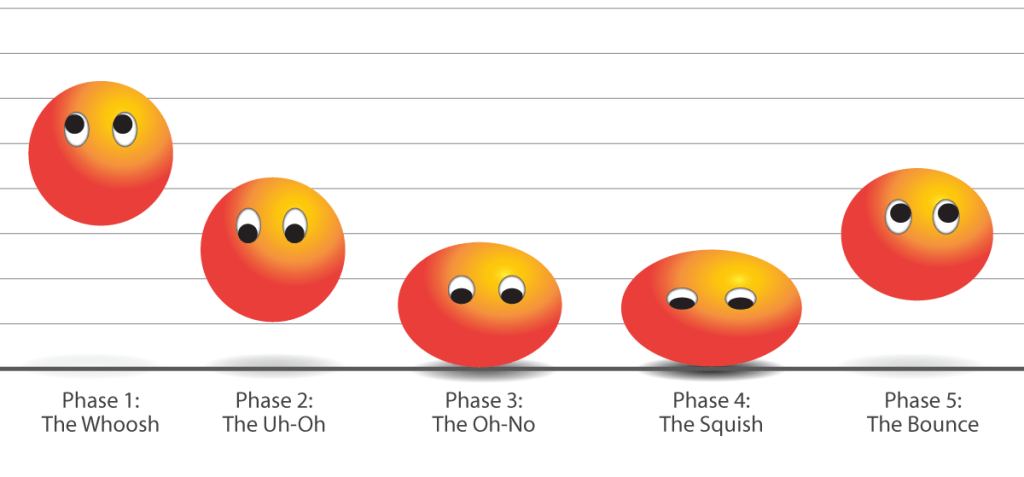
Phase 1: The Thrill of The Whoosh
You really have no control over how you’re launched out into the world. Once you’re off, you’re in continuous movement, interacting with all the objects around you (the ubiquitious nouns of people, places, and things). And so, regardless of the nature of your first or latest contact, here you are, sailing through the air. There’s wonder, there’s the rush of speed, the exciting feel of the air on your face. You’re flying high. But the universe has an interesting feature built in, something that Isaac Newton put a name to a few hundred years ago, and that thing is gravity. And one thing we know about gravity is that flying is temporary. What goes up must come down.
Phase 2: The Unknowing of Uh-Oh
Perhaps you swoosh through a hoop, changing direction, and now you see yourself moving towards the ground, something new. What’s going to happen? Will you be okay? Will it be fun? Will it hurt? Our uncertainty is just that—uncertainty. Not knowing. And most of us aren’t so fond of not knowing. Unless you’ve done this kind of thing a lot before, “uh-oh” is par for the course, flavored with however much of an optimist or pessimist you are, and by your past experiences of flying through the air.
Phase 3: The “No” in Oh-No
The moment of impact. Ouch. “NO,” you think, as you register the shock of hitting the ground, “I DO NOT LIKE THIS.” Part of you hurts, part of you is afraid, part of you is angry, and part of you thinks you never should’ve left the rubber tree to begin with, because this is not what you had in mind. A big part of you just wants to know when the pain will stop.
Phase 4: The Endurance of The Squish (and the Fear of The Splat)
In general, time is supposed to move consistently, but we’re just going to be honest: time in The Squish stretches out just like you do. The pressure can be painful, and your body and mind will not like it. You feel pushed into the ground, stretched out beyond what you think are your limits. Time in The Squish does not feel good. You may fear you will never regain your original shape. You may be tempted to give up hope. There are those who may thrive from the pressure in The Squish (a clue that it’s probably not their first bounce), but a lot of us simply fear this will be the end, that we will never recover, never be happy again. What we fear is not simply the pressure of The Squish. What we fear is that this is The Splat.

The Splat is a one-time-only event whether you are a human or a ball. The Splat is inevitable. Eventually, everyone will experience The Splat. (We are not making light of this, merely being honest.) The only guarantee we have as objects in space is that once we start moving, there will be a point when we come to a full stop. For the bazillions of bounces we’ll bounce in our lives, there will be one time where we will not rebound, where The Squish will not lead to The Bounce, and we will cease to exist in our current form. (What comes next we don’t know.) To face The Splat, whether our own or someone else’s, requires a great deal of bravery and kindness. But our great worry is that each time we enter a particularly intense Squish, we don’t know if it will be our Splat, so it’s unfortunately very easy to live in fear.
You might take this opportunity to point out that it would be more practical to avoid bouncing altogether and to opt for a life of rolling instead. Or, even better, hiding in the back of a shelf where you’re less likely to experience any movement at all. But even those won’t guarantee your safety, and what kind of life would that be, merely attempting to delay the coming of The Splat?
To live in fear sucks the joy out of everything. Yes, there are times when it’s wise to heed fear. But to choose it consistently is to deny our own resilient nature—the scientific fact that almost every single time, The Squish leads to The Bounce. We know that The Squish is hard. We have been there—many times, in varying degrees—and experienced countless moments of various stresses and pressures. So have you, so have your friends, and yes, so have the people you don’t even like very much. And that commonality is the biggest difference between being a round rubber ball and a human—we have company. When we are in The Squish, we can ask for help. We get to call someone we trust and say, “I am in The Squish. It hurts. I am afraid. Will you be here with me?” And there will be people who say yes. And though it seems scientifically counterintuitive, sometimes the people quickest to befriend you are there in The Squish themselves, right at that very moment.
But here’s the thing—The Squish is where the most energy is, even if you can’t feel it. It’s the answer to our question, “Where does the energy come from to keep moving?” It actually comes from the compression. And so if you can be patient and endure the slow-seeming time under pressure, however bleak or painful it seems, that support and that energy are what will propel you back up again and on to new adventures. That’s resiliency. That upward movement is the entrance to The Bounce.
Phase 5: The Joy of The Bounce
Oh, the great bounciness of bounce. The joy of being in the air again, moving intently toward whatever’s coming up next. Who knew that this was possible, that you’d get to fly again? You can delight, look around, and see new things. There’s new adventure here, new life on this side of The Squish. And yes, there’s likely another bounce coming, but now you know what to do. And you can keep an eye out for others in The Squish who might need your help. You get to take turns bouncing. And if you’re able, you can take some time to roll and rest until the next bounce.
So wherever you are, we’d ask you to take heart—your bouncy, round rubber ball heart. Whenever you experience The Squish, no matter how much pressure you’re feeling, know we are cheering for you. May you be refilled with air if you feel you’ve sprung a leak and all hope seems lost. We wish you friends. We wish you support. We wish you joyous release from The Squish, and even to make some small amount of peace with The Splat. We wish you the time and comfort to roll and rest—bounce after bounce after bounce. We wish you gladness and laughter. We wish you the bounciness of resiliency.
 The Serious Mirth Society